

You filled the NQT form. You built a resume in Canva, the one with the purple sidebar and the little skill rating circles. You uploaded it. Nothing.
TL;DR
1. The ATS resume format for freshers in India is a single column, text based PDF with standard section headings and no photo, tables, or icons.
2. For TCS NQT and most campus drives, the profile form is the real filter. Your resume just has to agree with it, exactly.
3. Mass recruiters screen on 10th, 12th, and graduation percentages, active backlogs, and year of passing before anyone reads your projects.
4. Cut the objective, the photo, the hobbies, the skill rating bars, and the declaration. That is roughly a third of most fresher resumes.
5. Projects beat coursework. Name the language, the tool, and what the thing actually does.
6. Expect 4 to 8 weeks of consistent applying before you can judge whether the format change is working.
It probably was not your CGPA. It was the sidebar.
Here is the thing most fresher resume guides skip: the ATS resume format for freshers in India is not really about beating a robot. It is about matching the form you already filled in. TCS, Infosys, Wipro and Accenture hire at a scale where your resume is checked against structured data, not read as a story. Get the two out of sync and you look like a mismatch before a recruiter ever opens the file.
Let’s fix that, section by section.
What Is an ATS Resume Format for Freshers in India?
An ATS resume format for freshers in India is a single column, text based resume that a parsing system can read cleanly. It uses standard headings, plain fonts, and no photos, tables, columns, or graphics. Education comes near the top with percentages and year of passing, because mass recruiters filter on those numbers first.
That is the whole definition. Everything else is detail.
The reason it matters: Jobscan’s 2025 Fortune 500 ATS Report found an applicant tracking system on 97.8% of Fortune 500 career pages. Indian IT services firms run the same category of software at even higher volume. TCS onboarded 44,000 trainees in FY26 and had already rolled out 25,000 campus offers, with CHRO Sudeep Kunnumal saying the company remains on track for around 40,000 freshers annually. Nobody is reading 40,000 resumes by hand.
One honest correction, because you will see this stat everywhere: the claim that ATS software auto rejects 75% of resumes is not well supported. A 2025 Enhancv study of 25 US recruiters pushed back on it directly. The software mostly ranks and sorts. But a badly parsed resume sinks to the bottom of the ranked list, and nobody scrolls that far. The outcome is the same. The mechanism is just less dramatic.
Why Do Freshers Get Rejected Before TCS Even Opens the Resume?
Because for a mass recruiter, your resume is not the application. The profile form is the application. The resume is the evidence.
When you register for TCS NQT, you type in your 10th percentage, 12th percentage, graduation percentage or CGPA, year of passing, branch, and backlog status. Those fields are what the system sorts on. The eligibility floor across TCS tracks is 60% aggregate in 10th, 12th and graduation, with no active backlogs at the time of joining.
So three things get you filtered out early, and none of them is your project quality:
- Your resume says 7.8 CGPA and your form says 72%. Mismatch. Looks like an inconsistency.
- Your resume buries education on page two. The parser expects it in a predictable place.
- Your resume shows the CGPA as a graphic or inside a table cell that does not extract as text.
There is also a timing thing worth knowing. The September 2026 NQT window has closed for new registrations. Prep aggregators including Testbook and Freshershunt report the next cycle as a 19 October 2026 test with registration closing 7 October 2026. TCS does not publish a public calendar of upcoming test dates on its own iON page, so confirm on tcsion.com before you plan around it. If you are reading this in September, you have about four weeks. That is enough time to rebuild a resume properly.
What Does a Mass Recruiter ATS Actually Parse?
It pulls structured text. It ignores or mangles anything decorative.
| The parser reads this cleanly | The parser drops or garbles this |
| Plain headings: Education, Skills, Projects | Custom headings: “My Journey”, “What I Bring” |
| Single column text | Two column and sidebar layouts |
| Standard fonts: Calibri, Arial, Times New Roman | Icon fonts, custom display fonts |
| Dates written as MM/YYYY | Dates inside graphics or infographics |
| Skills as a comma-separated line | Skill rating bars, star ratings, pie charts |
| Text based PDF or .docx | Scanned PDFs, images, resumes exported as PNG |
| Your degree spelled out: Bachelor of Technology | “B.Tech.” alone with no expansion anywhere |
The PDF itself is fine. That is a myth worth killing. Modern parsers handle text based PDFs well. The problem is what people put inside the PDF: tables, columns, and images.
Quotable: A fresher resume fails on parsing far more often than it fails on merit.
How Do You Build the Resume From the NQT Profile Outward?
Start with your form data, then build around it. Not the other way around.
- Open your NQT or campus profile form and copy the exact numbers. 10th, 12th, graduation, year of passing, branch, backlog status. These are now locked. Your resume must match them character for character.
- Put contact details on one plain line at the top. Name, phone, email, city, LinkedIn URL, GitHub URL if you have one. No photo. No address block. No headers or footers, since some parsers skip those entirely.
- Put Education second, as plain text lines. Degree, institution, percentage or CGPA, year. Write both formats if your college gives CGPA: “8.1 CGPA (76.9%)”. This clears percentage-based cutoffs without you having to guess the conversion.
- Add a Technical Skills line, comma separated. Pull the exact words from the job description or the NQT track you are targeting. If the JD says “SQL”, write SQL, not “database querying”.
- Write Projects next, two to three of them, three bullets each. Each bullet names a language, a tool, or a dataset. Say what the thing does and what you built, not what the topic was.
- Add Internships or Training if you have them, in the same bullet style. If you have none, skip the section entirely. Do not pad it.
- Add Certifications and Achievements last, one line each. Then stop. One page.
That order is deliberate. It puts filterable data where the parser expects it, and it puts your best evidence where a human’s eye lands next.
Quotable: If your project bullet does not name a language, a tool, or a dataset, it is not a technical bullet. It is a sentence.
What Should You Cut From Your Fresher Resume Right Now?
Cut these. On most fresher resumes this removes about a third of the page, and the page gets stronger.
- The career objective. “Seeking a challenging role in a reputed organization” tells a recruiter nothing. If you want a summary, write two lines naming your branch, your strongest stack, and the role you want.
- Your photo. Not standard on Indian tech resumes and a parsing risk.
- The declaration and signature block. Nobody has needed this since roughly 2010.
- Skill rating bars and percentages. “Python: 80%” means nothing and does not parse.
- Hobbies, unless directly relevant. Competitive chess for an analytics role, sure. “Listening to music”, no.
- Father’s name, marital status, date of birth, full postal address. Recruiters do not need it and it eats space.
- Coursework lists. Your degree already implies them.
You now have room for a third project. Use it.
Does a Canva Template Actually Hurt Your Chances?
Sometimes yes, but the template is not the villain. The layout is.
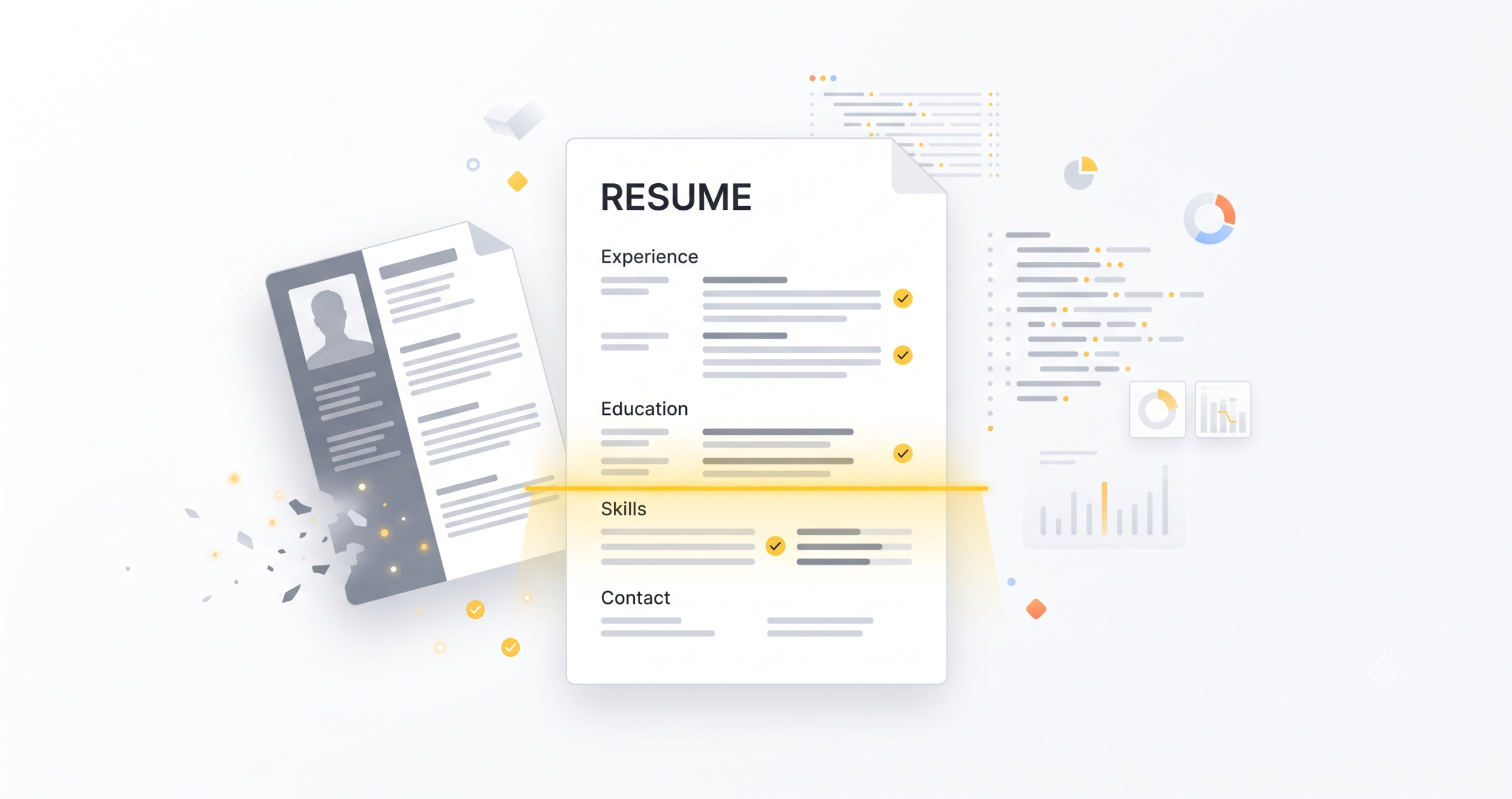
A single column Canva template with plain headings parses fine. A two column one with a colored sidebar, an icon set, and your skills as circles is where it breaks. The parser reads left to right across the page, so a sidebar layout can interleave your email address into the middle of your project description.
The realistic test: open your PDF, select all, copy, paste into a plain text file. If it reads top to bottom in the right order, you are fine. If it comes out scrambled, so does the parsed version. That takes twenty seconds and tells you more than any resume score.
Quotable: The best fresher resume in India in 2026 is boring on the outside and precise on the inside.
What Happens When Someone Actually Fixes This?
Here is a pattern we see constantly at Careerboat.ai.
Take a student like Ritika, final year IT at a private college near Kanpur, 7.9 CGPA, no backlogs. She had a two column resume with a photo, a skills wheel, and an objective that mentioned a “dynamic organization”. Twelve applications, no callbacks, and she had started assuming her college tier was the problem.
The rebuild took about ninety minutes. Single column. Education second with both CGPA and percentage. Objective gone, photo gone, declaration gone. Two projects rewritten so each bullet named Python, pandas, or MySQL, and said what the project actually did instead of what it was about. Skills line matched to the NQT track wording.
The resume was not more impressive. It was more readable, and it agreed with her form. That is usually the entire gap.
Do AI Resume Tools Actually Help Freshers, or Just Reformat?
The good ones do two things you cannot easily do alone: check parsing, and match your wording to a specific job description.
Careerboat.ai’s resume builder generates single column, parse safe output by default and rewrites your resume against a pasted JD, so the skills line and project bullets pick up the words that role actually screens for. That matters more in 2026 than it did two years ago. TCS CHRO Sudeep Kunnumal has said 60% of the company’s FY26 fresher hires were AI skilled, up from 10 to 15% three years earlier, which means the vocabulary recruiters filter on is moving fast.
Where AI tools do not help: they cannot invent a project you did not build, and they cannot fix a percentage below the cutoff. Anything promising you a guaranteed shortlist is selling you something.
How Long Before You See Results?
Give it 4 to 8 weeks of consistent applying before you judge anything.
Fixing your format removes a barrier. It does not create demand. Campus season volume also moves in waves, and a rejection in week two might just mean that drive filled its seats. Once your resume does reach a human, a 2023 study by Jan Tegze tracking 114 recruiters found average review times of 17 to 46 seconds, and The Ladders’ widely cited eye tracking study put the initial scan at about 7.4 seconds. Short either way. Your top third does the work.
One honest limitation: this advice is built for mass recruiters and campus drives. If you are applying to a 15 person startup where the founder reads every application, a more designed resume is fine and sometimes better. Match the format to the filter.
Where to Start Tonight
Do the copy paste test on your current PDF. If it scrambles, you found your problem, and the fix is one layout change away from done.
Then rebuild in this order: form data first, education second, projects third, everything decorative deleted. It is one evening of work, and it is the highest leverage evening in your placement season.
If you want the parse check and the JD matching handled for you, the resume builder at Careerboat.ai does both free.
FAQs
What is the best ATS resume format for freshers in India?+
A single column, text-based PDF with standard headings and no photo, tables, or icons. Put contact details on one line, education second with both CGPA and percentage, then technical skills, then two or three projects. Keep it to one page. This format parses cleanly in the systems TCS, Infosys and Wipro use for mass hiring.
Is a PDF or Word file better for a TCS NQT resume?+
Both work if the file is text based. A PDF exported from Word or Google Docs parses fine. The real risk is not the format but the layout inside it: two columns, sidebars, tables and images are what break parsing. Never upload a scanned or image based resume, since there is no text for the system to read
Should freshers include a photo on an ATS resume in India?+
No. Photos are not standard on Indian tech resumes and they add a parsing risk, especially if your name or contact details sit inside the image block. The space is better spent on a third project. The only exceptions are roles where appearance is genuinely part of the job, like aviation or on camera work.
How long should a fresher resume be for campus placements?+
One page. You have limited work history, and a mass recruiter is scanning for education, skills and projects. A second page usually means padding: coursework lists, hobbies, or a declaration. If you are struggling to fill one page, add a real project rather than stretching the formatting.
What CGPA or percentage should a fresher put on a TCS NQT resume?+
Write exactly what your NQT profile form says, and include both formats: “8.1 CGPA (76.9%)”. TCS screens on 60% aggregate in 10th, 12th and graduation, with no active backlogs at joining. A mismatch between your resume and your form looks like an inconsistency, and that is an easy reason to filter you out.